
Castalia 343
Change of hats

Dear Friends,
In Castalia 340, I shared a song by Schubert, The Linden Tree; it tells of departure from the house where one has hoped for happiness:
The cold wind was against me,
It froze me to the quick;
The hat flew from my head,
But I did not turn back…
A comment from Julia Grella O’Connell opened a door for me:
…to be abroad hatless went against convention…
that he does not turn back
…shows his increasing alienation from society and his acceptance of this transformed state…
This transformed state…
In Chapter 2 of his Psychology and Alchemy, Dr. Jung explores a series of dreams, dreams emerging in the awareness of “a young man of excellent scientific education” — the quantum physicist Wolfgang Pauli. In the first,
The dreamer is at a social gathering. On leaving, he puts on a stranger’s hat instead of his own.
As Jung writes,
The hat, as a covering for the head, has the general sense of something that epitomizes the head. Just as in summing up we bring ideas “under one head” (unter einen Hut), so the hat, as a sort of leading idea, covers the whole personality and imparts its own significance to it. Coronation endows the ruler with the divine nature of the sun, the doctor’s hood bestows the dignity of a scholar, and a stranger’s hat imparts a strange personality. Meyrink uses this theme in his novel The Golem, where the hero puts on the hat of Athanasius Pernath and, as a result, becomes involved in a strange experience. It is clear enough in The Golem that it is the unconscious which entangles the hero in fantastic adventures. Let us stress at once the significance of the Golem parallel and assume that the hat in the dream is the hat of an Athanasius, an immortal, a being beyond time, the universal and everlasting man as distinct from the ephemeral and “accidental” mortal man…
This change of hats, this movement from mortal man to everlasting, is the story too in Schubert — the story of Winter Journey, the cycle to which our song belongs. The winter journey is the journey of our soul, the long road from illusion to truth. We move away from the fickle, to find refuge in the eternal.
Reality is fractal, so within this greater movement are many smaller; one may need, for example, to find a better place for the children, or to move from the house of fear — from trying to be good enough — to the house of love.
One’s hat is also a level. As Maurice Nicoll writes, in his Psychological Commentaries on the Teaching of Gurdjieff and Ouspensky (Volume 1, page 1), “...the level of being of a man attracts his life…As long as there is no change in the level of being, the personal history of a man remains the same. Everything repeats itself…”
When one sees one’s lowness, one is already higher; to see one’s fear, for example — to know, “this is fear” — is already to be that older, wiser person who can take care of the fear.
At the end of Winter Journey, the young man meets such a person — a hurdy-gurdy player, who no matter what befall him, continues to turn the crank; continues to make contact with the real; continues to pray. May we all find such a person in ourselves!
In the coming months, God willing, I will share the entire cycle with you; thank you so much for listening, and for your support.
With every good wish,
Ishmael
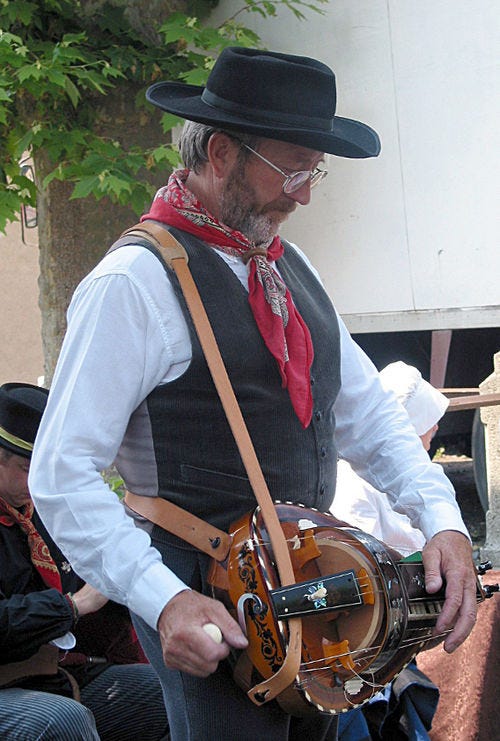
Hurdy gurdy player, Saint-Jean-des-Ollières, Puy-de-Dôme (France).
Photograph by Jean-Pol Grandmont
Dear Friends, I tutor music theory online — for details and testimonials, please see my website!
Thank you for the quote, Ishmael! I've never been sure what to make of the hurdy-gurdy man, though. It always seemed to me as if Winterreise's protagonist becomes so alienated from society that he accepts the Leiermann's state of complete forsakenness and goes off with him.
Absolutely brilliant connection between the hat symbolism and the hurdy-gurdy player at the end of Winter Journey! The idea that transformation requires not turning back, that once we put on the stranger's hat we become different people, really hits home. I remember when I left my hometown for college and realized I could never quite fit back into my old life the same way. The image of the hurdy-gurdy player continuing to crank despite everything kinda reminds us that staying grounded in reality is its own form of spirtual practice, dunno if that makes sense but it's what stuck with me.