
Castalia 355
On the stairway

Dear Friends,
I often think of this image:
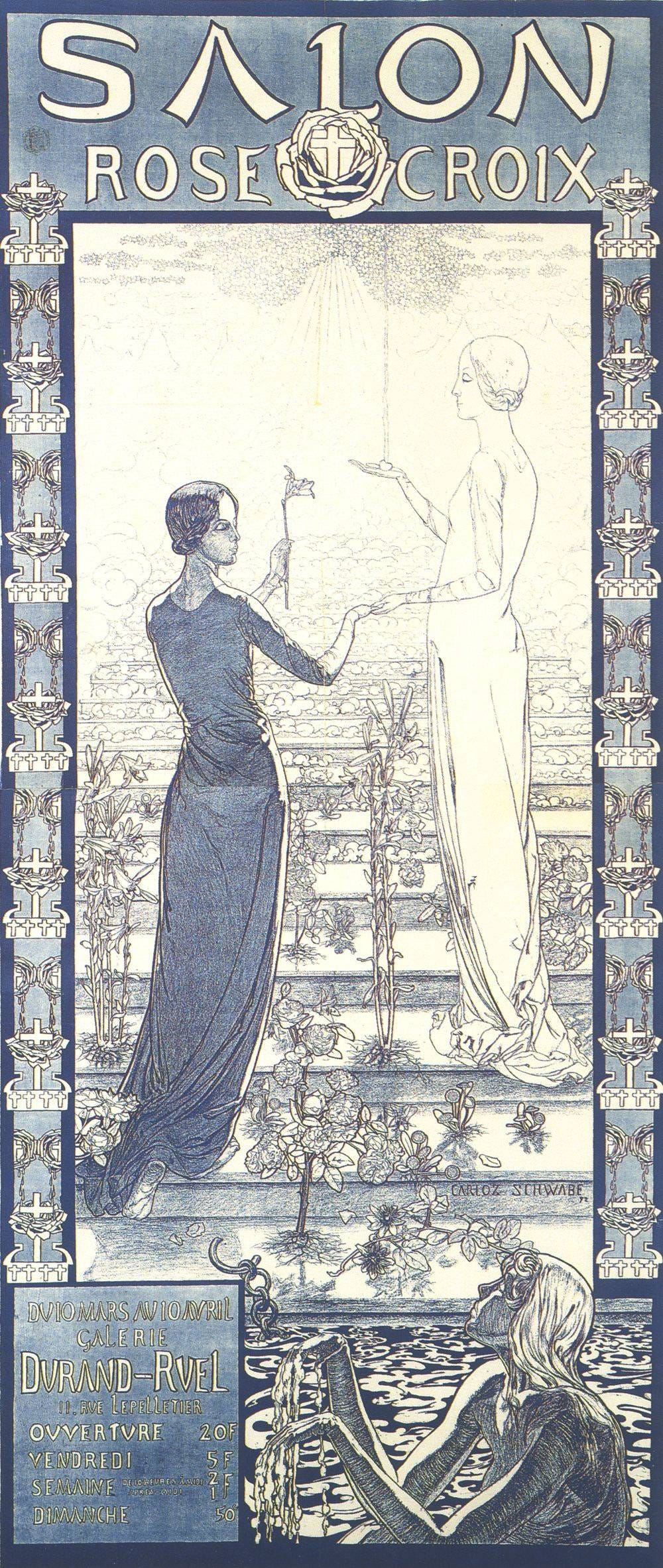
Lithograph by Carlos Schwabe for the Salon de la Rose-Croix, 1892.
That within one which is receptive — the soul — is on a journey from darkness to light, water to fire. She is mounting a stairway.
The Salons de la Rose-Croix, offered from 1892 to ‘97, were organized by Sâr Joséphin Péladan (1858–1918), Grand Master of the Ordre du Temple de la Rose+Croix. As Professor Laurinda S. Dixon writes, “they were the most fashionable events of the decade…”1
Music was at their heart; Péladan’s inspiration was Wagner, and the notion of a total work of art: the union of music, word, and image. He saw Wagner as “a fellow ‘magus’” 2 — and indeed, once the suggestion has been made, it’s impossible not to see the operas as a form of ceremonial magic! If the things of this earth correspond to things in the worlds beyond, one may wish to enlist, not only one such correspondence, but many — not only word, but tone; not only tone, but image. And the Salons involved incense as well.
In Debussy, one may hear it, what Péladan was after: “…a manifestation of art against the arts, of the ideal against the ugly, of the dream against the real, of the past against the infamous present, of the tradition against the joke.”3
Debussy is not an Impressionist4, conveying how things appear; his music lives in the realm of legend from which these appearances emerge. He was in fact an initiate5, entering the Ordre Kabbalistique de la Rose-Croix — the slightly antecedent grouping of which Péladan’s was a shard — in 1891, together with his friend Satie.
In contemplating this image, I remember: the light of the Sun, the light of Christ, is already in the water. This is one meaning of the ichthus:

And I think: as I climb the stairs, it will not work to skip steps. If I ask not, “What shall I do?” but only “What is?” I will remain in the climbing.
Thank you so much for reading, and for your support!
With every good wish,
Ishmael
Coaching for musicians: I help performers and composers find deeper meaning in their work through insight from music theory. For details and testimonials, please see my website!
From her review, in Nineteenth-Century Art Worldwide, of “Mystical Symbolism: The Salon de la Rose+Croix in Paris, 1892–1897, Solomon R. Guggenheim Museum, New York, June 10–October 4, 2017”
Dixon, ibid.
Quoted in Music and the Convergence of the Arts in Symbolist Salons: From the Salons de la Rose†Croix to the Salons d’Art Idéaliste by Lucien Midavaine, also in Nineteenth-Century Art Worldwide; this is a very interesting, very helpful essay, with details of some of the music performed and important context!
As Raul Passos points out in Rose of the Occult, Cross of the Revealed: Esoteric Evidence in the Work of Claude Debussy, Rose+Cross Journal, vol. 15
See Raul Passos, Claude Debussy & Erik Satie: Two Rosicrucian Composers